that can only be the fruit of musical love."
By Christopher O'Riley
host of From the Top, National Public Radio
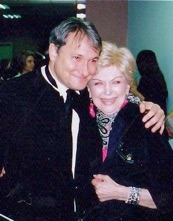
Chris O’Riley with Zhanna 2009
Publisher’s Weekly
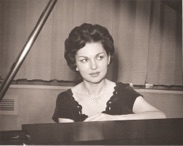
In this remarkable recreation of the WWII years, Dawson, a columnist at the Orlando Sentinel, writes about his mother, pianist Zhanna Arshanskaya in an account reminiscent of Wladyslaw Szpilman's The Pianist. As a child in the Ukraine, Zhanna was offered a scholarship to the Moscow State Conservatory.
Her life changed in 1941 when Nazis grouped her Jewish family with thousands to be executed; Zhanna and her sister, Frina, escaped to roam the countryside as fugitives, hiding and surviving. With a new name and a non-Jewish identity, Zhanna performed for unsuspecting Nazis. Arriving in New York in 1946, the sisters enrolled at Juilliard on scholarships. Zhanna married violist David Dawson, and the couple moved in 1948 to Bloomington, Ind., joining the music faculty at Indiana University.
To research his mother's homeland, Dawson traveled to Ukraine, including Dorbitsky Yar, where 15,000 Jews were murdered, among them Zhanna and Frina's parents. On a memorial listing the dead, Dawson was shocked to find his mother's name: “I had come that close to nonexistence.” With italicized selections from his mother's own writing, Dawson skillfully weaves the story of her life and music into a vibrant tapestry, tattered and torn, yet triumphant.
~*~*~*~*~
By Mona Golabeck
host of The Romantic Hours national radio program,
Grammy-nominated pianist, and author of
The Children of Willesden Lane
"Summoning all the colors of a Chopin prelude, Greg Dawson has painted a vivid picture of his mother from her
fairy tale childhood in Ukraine to her
final escape from the Nazis and her triumphant voyage to America.
A wonderful, staggering achievement."
~*~*~*~*~*
MIDWEST BOOK REVIEW
Survival leads people to do the strangest things, like perform for those they hate. "Hiding in the Spotlight: A Musical Prodigy's Story of Survival 1941-1946" is the intriguing true story of Zhanna Arshanskaya and her own unique tale of escaping the wrath of Nazi Germany. Under their very noses she became quite the star with her piano performances, hiding her Jewish heritage until freedom finally came. A moving and unique holocaust story, "Hiding in the Spotlight" is not one to be missed for Holocaust studies collections.
~*~*~*~*~
Kirkus Reviews
A patiently recounted narrative, especially informative about Nazi atrocities in Ukraine.
The inspiring story of a Ukrainian Jewish girl trained as a pianist who performed for the Nazis to avoid capture. The author's mother, Zhanna Arshanskaya, did not discuss her plight with her son when he was a child living in "blissful ignorance" with his musician-teacher parents in Bloomington, Ind.
Seasoned journalist Dawson, now a columnist for the Orlando Sentinel, re-creates the terrifying war era by furnishing brief first-person memories in the voice of his mother that alternate with the main historical narrative, which begins with Zhanna and her younger sister, Frina, learning to play the piano at the behest of their father, Dmitri, a candy maker and violinist.
As the sisters' progressed in their musical studies, the family moved to Kharkov so that the girls could attend the city's prestigious conservatory. But in 1941, when Zhanna was 14, "the German army moved inexorably, and murderously, across the Ukraine." As Zhanna's family was marching toward the killing ravines, Dmitri urged his daughter to flee:"I don't care what you do, just live. Go!"
After escaping into the countryside, Zhanna was eventually reunited with her sister. The young girls relied on strangers' kindness and were coached to reinvent identities for themselves until their piano-playing in an orphanage caught the attention of the music school. They played for the German soldiers and then were sent as a troupe of performers to Berlin and-in a sick twist-on tour to slave-labor camps. Eventually the sisters' musical gifts earned them passage to America and enormous later achievement, as Dawson gracefully sums up.”
~*~*~*~*~
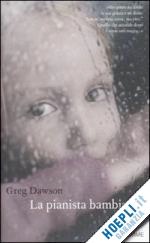
The Italian Version: “La Pianista Bambina”
28,000 copies
have been sold in Italy in the first 6 months since publication.
We thank our wonderful readers in Italy, Korea and France for their support and AMAZING notes to us.
A Lovely Review By MAMIKAZEN
An Italian Reader of “La Pianista Bambina”
Saturday, January 30, 2010
Greg Dawson, "The Pianist child."
There are books you buy there because a friend recommended them, or because if they have read something in a newspaper, or if they have heard about.
There are books that are read for pleasure, out of duty, out of spite, out of boredom, to kill time. Books that you read and you just forget them closed, books that remain to vegetate on the bedside whole seasons, sad and disheveled as potted plants neglected.
In the meantime you reach your three and you buy the ravioli for dinner, prepare the sauce, but it really sets her mind're already in the book and can not wait that after dinner all are dedicated to their favorite activities -- pennica, expense all'Ipercoop - cookies before you roll up on the sofa reading. And do not get up again until page two hundred seventy-nine: the last.
This book can be read as the story of Zhanna, a Ukrainian children happy and loved, with a beautiful family and an exceptional talent for music, a little girl who is now an American woman, happy and loved, with a nice family and so many promises maintained as a pianist, performer and teacher. In between, the killing of thirteen Jews Drobitsky Yar, whose only surviving child and her sister.
It 'also the story of two sisters, their indomitable instinct for survival and a joy of life that continues to support them when all around there is nothing left.
But it is mainly a history of pianos.
Pianos with their own personality - the German one, acquired by the father of Zhanna because "the Germans manufacture pianos and are best educated men and courteous," those grand concert halls where you listen to teachers, where the Conservative and Zhanna sister Frina invariably affect the hearts and minds of their teachers, as Regina Horowitz, sister of Vladimir, ghost those found by chance in the shelters for the displaced prisoners, piano with clear and authoritative voices now, magic, distinguished, now feeble, forget the war and helpless, like the voice of the piano that impossible and Zhanna Frina play one evening in Germany for twelve hundred survived the death camps immediately after the end of the conflict.
"For the survivors of the Holocaust, the most important was the event itself, not the way we played. Their presence was in itself a concert without sound.
Beethoven, Mendelssohn, Brahms, Liszt and Schubert were all there for us. They had come all to celebrate our freedom. That was how they wanted those composers in Germany and around the world, free. There were also our mother, our father, grandfather and grandmother. Had returned alive to hear and celebrate with us. "
The music survives intact the horror experienced by Zhanna and told his son Greg over sixty years later.
The music lives on, as the score of Chopin's favorite, hidden under his shirt the day when he leaves the house for Zhanna never to return.
<<<<>>>>
FROM NPR
"Growing up, Greg Dawson may not have known much about his mother's past, but he did know she was special. Unlike the other mothers in the small town of Bloomington, Ind., Zhanna Arshanskaya Dawson spoke Russian and English — and she played the piano beautifully for hours each day.
What Greg Dawson didn't know at the time was that his mother had used her piano skills to survive the horrors of World War II — a story he recounts in his new book, Hiding in the Spotlight.
"I knew in a vague sense that she had been through the war, but I really knew nothing about the story that's outlined in the book," he tells Scott Simon.
The story he didn't know is an extraordinary one: When his mother was 14 years old, she and her family were rounded up by German forces where they lived in the Ukraine. As they were being marched off on the way to be executed, her father bribed a Ukrainian guard to look the other way while his two daughters ran into the forest."
Read more here:
Hiding In Spotlight, Jewish Pianist Survived WWII : NPR
__________________
Zhanna performs Debussy, L'Isle joyeuse
Excerpt: